
LTM BlueVerse AgenTraceIQ lets firms rewind AI agent actions
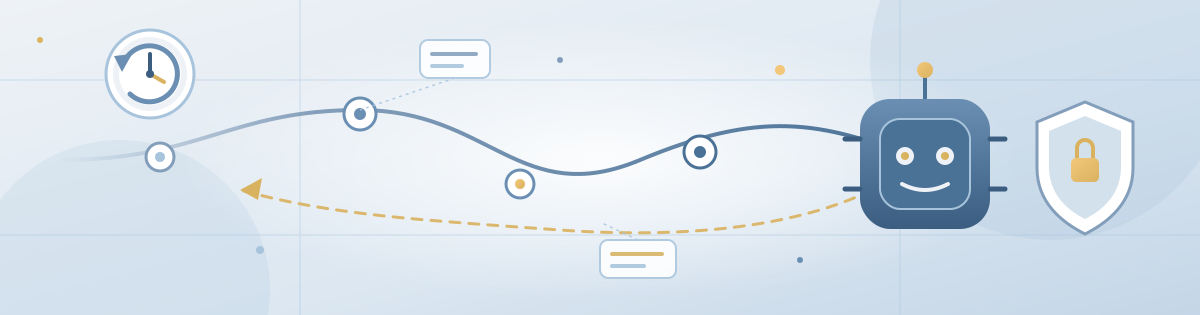
LTM has introduced BlueVerse AgenTraceIQ, a service aimed at companies that want to run AI agents in production. It lets them watch what those agents do, limit what they can touch, and undo changes when an agent acts in ways nobody intended.
The offering is built on Rubrik Agent Cloud. LTM adds its own AI governance work and managed services on top. Rubrik describes itself as a Security and AI Operations Company and is best known for data backup and recovery.
Part of Rubrik's Project Hourglass
The launch comes through Rubrik's Project Hourglass. Under this program, LTM and other large Global Systems Integrators, consulting firms that design and run IT projects for big enterprises, work with Rubrik to deliver Rubrik Agent Cloud for Anthropic's Claude Code to their corporate clients.
According to the companies, the goal is to give organizations the security, governance and resilience they need before they deploy agentic systems at scale.
"As AI agents increasingly act autonomously, the stakes for enterprise security and resilience have never been higher," said Alok Agrawal, Chief Solutions Officer at Rubrik. He said the partnership is meant to help organizations shift from reactive risk management to a proactive framework, so they can "innovate with AI at speed without compromising their operational integrity."
Visibility, guardrails and rollback
The product combines three things: agent observability, governance and resilience.
On the observability side, it tracks agent activity continuously. It ties each agent action back to the prompt, the plan and the tool calls behind it. LTM says this makes agent behavior easier to explain and audit, and helps teams trace the root cause when something goes wrong.
For governance, the platform enforces policy-based controls and zero-trust access. That means agents get only the access they are explicitly allowed. This matters as agents gain broader permissions inside corporate systems. Earlier research has shown that AI agents can keep data access after their tasks end.
The resilience piece is the rewind function. If an agent makes an unintended or destructive change, the service can restore affected systems, data, configurations and repositories.
BlueVerse AgenTraceIQ works with several major agent ecosystems:
- Microsoft Copilot Studio
- Salesforce Agentforce
- Amazon Bedrock
- Anthropic Claude
- custom-built frameworks
Services wrapped around the tool
LTM is also bundling consulting and operations work with the technology. The package includes AI Resilience Assessments, Governance Framework Design, Deployment & Integration Services, and Managed Governance Operations. The company says these are meant to help clients build operating models for agentic AI, improve compliance readiness and get more operational certainty.
"Organizations need the ability to understand agent behaviour, establish accountability, and respond quickly when unexpected outcomes occur," said Krishnan Iyer, Chief Growth Officer at LTM. He added that the offering is intended to move enterprises "from experimentation to trusted, production-scale AI operations."
Our Take
The pitch reflects a shift in how vendors talk about AI agents. The focus is moving from what agents can do to what happens when they get it wrong. The rewind feature is the notable part. It treats agent mistakes much like ransomware or bad configuration changes: something to be recovered from, not just prevented. That fits Rubrik's background in backup and recovery.
This matters because agents are already causing real incidents. In recent weeks we have covered cases such as the DIVD breach by an autonomous AI agent. The concern is no longer theoretical. Linking actions to prompts and tool calls could also help with audits, as regulators pay more attention to AI accountability.
Some questions remain open. It is worth watching how fine-grained the rollback really is in complex environments. Undoing changes across connected systems is rarely clean. It will also be telling whether other Project Hourglass integrators launch competing packages, and whether customers adopt these controls before an incident rather than after one.