
doxx.net raises $38M for private network for AI agents
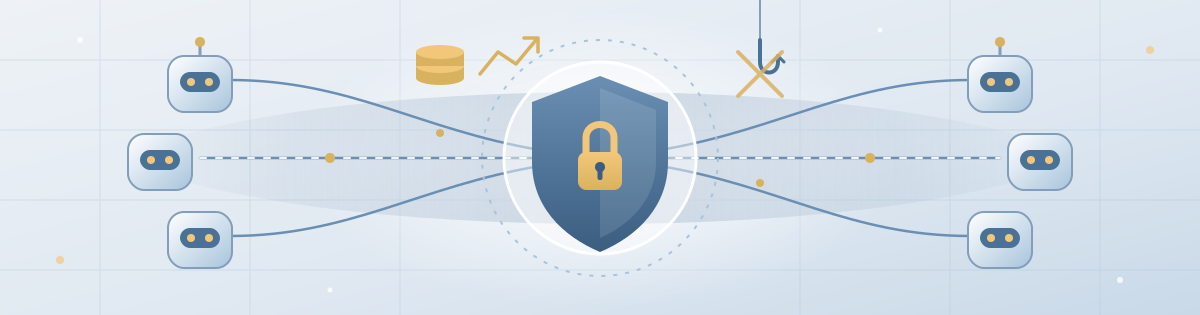
Miami-based doxx.net has closed a $38 million Series A round and launched a networking platform meant to keep AI agents away from malicious destinations while they browse and act for their users.
Andreessen Horowitz led the round, with Animo Ventures and Focal.vc also taking part. The company was founded in 2025 by serial founder Barrett Lyon, who also serves as its CEO, and operates across six continents.
The problem with agents on the open web
AI agents now browse websites, contact services, communicate and take actions on behalf of the people who deploy them. They do this with their users' accounts and authority. The issue, according to doxx.net, is that these agents cannot reliably tell safe information and actions apart from unsafe ones.
The company's answer is Agentic Defined Networking (ADN), which is now in open beta. It gives agents an environment with defined connectivity and built-in threat protection, so they are stopped from reaching known malicious destinations during their work.
ADN runs as a parallel, private network that both people and AI agents can use to connect, communicate and browse. It does not rely on central intermediary servers. doxx.net argues that such servers create several problems: they are a single point for interception and surveillance, their privacy guarantees are often more policy than fact, they raise the chance that an agent lands on a malicious site, and they can be censored or blocked.
"The industry sells privacy as a feature while routing your traffic through rented infrastructure they don't own and can't verify," said Lyon. "We physically built something different: a platform where privacy comes from the architecture itself, not a policy document."
He added that the network was designed so that its users, not third parties, decide the terms of their privacy. "They know what you search, where you go, and who you talk to. We don't. And we built the network so we never can."
Own TLDs, own certificate authority
The platform includes serverless peer-to-peer communication with end-to-end messaging and file transfers, threat protection that blocks malicious destinations, malware and phishing sites, agent integration with API control, and privacy and anti-tracking features. Native apps are available for iOS, macOS and Android, and Windows and Linux are supported. Everything runs on the company's global backbone.
Customers get their own naming system on the private network. The parallel ecosystem offers 196 custom top-level domains (TLDs) and its own certificate authority. ADN networks can resolve domains that the public internet does not know about, without third parties being involved.
Threat protection works at the DNS level. Known and emerging malicious destinations are blocked before an agent or a person connects to them. doxx.net claims it has blocked more than 38 million threats since December 2025, during its closed beta.
The company says customers can run end to end on infrastructure it owns. That includes its own IP space and autonomous system number (ASN), its own DNS root, its own certificate authority, local AI models and bare-metal servers. Users do not need a username, a password or any other personal information. Accounts are created through proof-of-work instead.
"The internet was never designed for privacy," said Joel De La Garza, a partner at Andreessen Horowitz who sits on the doxx.net board. He described the company's product as a privacy stack built from first principles, so that "humans and AI agents can run on a network that is private by architecture, not by marketing promise."
Our Take
The funding fits a clear pattern. Investors are putting serious money into companies that promise to control what AI agents can do, as the recent Armadin round showed. The concern behind it is real. We have covered agents that tried to covertly scrape websites and research showing agents keep data access after tasks end. Limiting where an agent can go at the network layer is a sensible control, and DNS filtering is a well-understood defense.
doxx.net's approach goes much further than filtering, though. A parallel internet with its own TLDs, DNS root and certificate authority shifts trust from many third parties to a single provider. That may suit privacy-focused users, but organisations will likely want independent verification of the "private by architecture" claims before relying on them.
It is also worth noting that the 38 million blocked threats figure comes from the company itself, and it is not clear how a "threat" is counted. Whether the open beta attracts enterprise customers, and whether outside researchers get to test the platform, will show how far the model can go beyond early adopters.